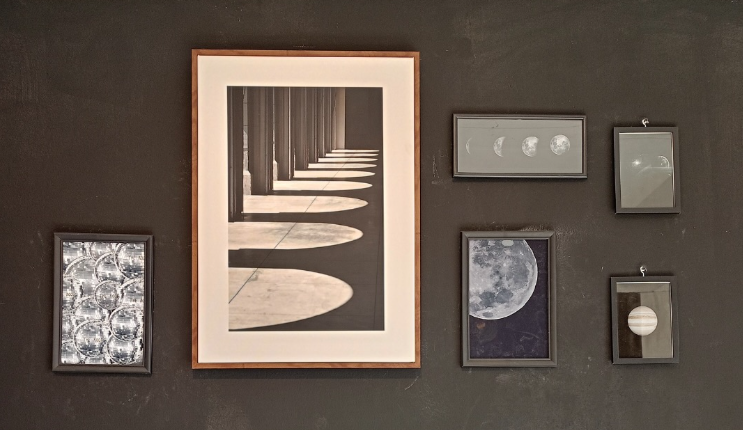
Framing is usually approached in one of two ways: perfunctory, or preventative. An afterthought once the “real” decisions are made. Or a conservative measure, something practical, almost bureaucratic, to protect the artwork and hold it in place. In this way, frames are treated as mere boundaries: functional, invisible, unremarkable. But to see a frame only as a container is to overlook its transformative potential.
Fundamentally, framing is protective. If an artwork were to fall from the wall, the frame absorbs the first impact, sparing the work itself from damage. It also protects against slower, subtler forms of harm: pins through paper, tape marks, adhesive residue, or repeated handling. Contemporary framing goes further, defending artworks against UV light, moisture, warping, dust, and insects, the invisible forces that cause the most lasting damage over time.
Yet framing does more than preserve. It shapes how we see.
Why do we frame things? At its most basic level, framing is an act of selection. By placing a border around an image, we are saying, “Look here. This matters. Ignore the wallpaper, the light switch, and the dust on the shelf, focus on this.”
A good frame creates a “breathing space” for the art. This is often achieved through the mat (or mount), the border of cardstock between the image and the frame. A wide, generous mat doesn’t just make the artwork look larger; it provides a neutral zone where the eye can rest before engaging with the image. Think of a small, precious sketch floating in a sea of creamy white matting; the emptiness around it amplifies its importance.
The frame acts as an extension of the artwork, reinforcing its character rather than competing with it. It can clarify the artist’s intent, strengthen the mood of the work, and guide how it is read. A well-chosen frame does not draw attention to itself. Instead, it sharpens the viewer’s engagement with the image it surrounds.
A common mistake is choosing a frame to match the sofa or the curtains. But furniture changes, art is often forever. Paintings usually require different approaches to framing, depending on the subject matter and material language. As seen below, modern abstract works tend to benefit from a lighter, more contemporary approach. Floater frames work particularly well here, allowing colour and form to remain the primary focus. By contrast, classical oil paintings often demand visual weight, whether through traditional gilded frames or more contemporary deep-set ones. In case of older paintings especially, an ornate gilded frame helps situate the work firmly within its historical context. Such frames carry their own sense of time, echoing the history of the object they contain.
Works on paper pair more naturally with mat boards and simple frames, which give line, colour, and composition space to speak without interruption. Photographs also benefit from minimal framing that recedes into the background.

While you shouldn’t match the frame to the sofa, you must consider the vibe of the room. A frame should act as a bridge between the artwork and its surroundings, helping the piece feel grounded rather than imposed. It mediates scale, tone, and presence, ensuring the artwork neither overwhelms the space nor disappears within it.
A heavy, Victorian rococo frame will look suffocating in a minimalist, industrial loft. Conversely, a sleek aluminum frame might look sterile in a cozy, book-filled study. The goal is to create harmony, a sense that the artwork belongs, without losing its individuality.
A frame is the period at the end of the sentence. It completes the thought. When done poorly, it is a distraction but when done well, the frame disappears. You don’t see the wood; you see the vibrancy of the paint. You don’t see the glass; you see the emotion of the image.
The next time you hold something worth keeping, be it a postcard, a diploma, a child’s drawing, remember that how you package it changes how the world receives it. That is the art of framing.
December 30, 2025
“Art washes from the soul the dust of everyday life.” – Pablo Picasso The wonder of experiencing and engaging with art can feel elusive, even exclusionary. Many imagine it as belonging only to the realm of the select few “in the know,” fluent in the language of art. For […]

Navigating the art world can be daunting. Prices aren’t always transparent, authenticity can be difficult to confirm, and opportunities often circulate in exclusive circles. For both seasoned collectors and first-time buyers, one question often arises: how do I make the right choices with confidence? This is where an art advisory […]
Buying art is an experience that blends passion, curiosity, and investment. For some collectors, it’s about building a meaningful connection with a work that inspires and resonates. For others, it’s about adding a valuable asset to their portfolio that they may appreciate over time. Whatever your motivation, one fact remains […]