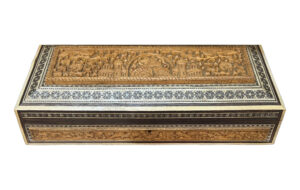
The distinction between fine and decorative art is often presented as a rigid hierarchy, yet to look at a 19th-century Hoshiarpur mirror or an intricately carved Indo-Portuguese side table is to realize that this boundary is far more porous than history suggests. At its core, the conversation between these two categories is a study of intent, interaction, and the shared pursuit of excellence.
To understand their intersection, one must first look at their traditional foundations:
Fine art is traditionally viewed as an end in itself. When we look at the emotive, angular lines of an MF Husain or the meditative quality of a VS Gaitonde, we are engaging with works that demand observation and introspection. Beyond their surface, the value of these works lies in their ability to function as a window into an artist’s imagination, capturing an aesthetic, intellectual, or emotional expression that might otherwise remain intangible. Whether it is meant to stir emotions or spark thought, fine art is designed to appeal directly to our senses, an experience that exists solely for the sake of the encounter.
Decorative art, conversely, insists that the items of our daily lives should be as thoughtfully crafted as any canvas. These pieces represent a commitment to elevating the everyday, ensuring that the objects inhabiting our private spaces carry the same weight of intent as those hanging on a gallery wall. A piece of Anglo-Indian furniture, for instance, is not merely a seat or a surface; it is a narrative of cultural integration, material durability, and the skilled labor of artisans who balanced form with function.
In the contemporary landscape, these distinctions between fine and decorative art are blurring each day. Modern collectors no longer see a divide but a wide spectrum. We see this blurring most clearly in the work of artists like Mrinalini Mukherjee, whose knotted hemp sculptures defy easy categorization, existing simultaneously as monumental forms and homages to traditional craft techniques.
This synergy is rooted in the fact that both disciplines demand technical knowledge and an acute understanding of aesthetic form. For instance, the scientific precision required to master the “viscosity” of a Krishna Reddy print mirrors the exacting hand-eye coordination needed for the delicate inlay of a precious-wood cabinet. In both cases, the creator must possess a deep mastery of their material to translate a vision into a physical reality.
One could argue that fine art tells us what a culture was thinking, while decorative art tells us how that culture was living. While fine art occupies the walls of our galleries, decorative art occupies the intimate spaces of our homes, creating what Rabindranath Tagore described as an “intimate relationship between our inner being and the universe at large.”
For the contemporary collector, the goal is often not to choose one over the other, but to infuse both. A thoughtful collection recognizes that a painting and a period table can both possess cultural resonance and enduring value. Whether it is a bold Souza artwork or an elegantly proportioned colonial table, the common thread is excellence in craftsmanship and the ability to form a lasting impression on those who live with them.
Ultimately, fine and decorative arts are part of the same creative field. One provides a window into an artist’s imagination, while the other shapes the aesthetic setting of our daily lives. Both are essential to a complete and thorough understanding of our artistic heritage.
February 19, 2026
“Art washes from the soul the dust of everyday life.” – Pablo Picasso The wonder of experiencing and engaging with art can feel elusive, even exclusionary. Many imagine it as belonging only to the realm of the select few “in the know,” fluent in the language of art. For […]

Navigating the art world can be daunting. Prices aren’t always transparent, authenticity can be difficult to confirm, and opportunities often circulate in exclusive circles. For both seasoned collectors and first-time buyers, one question often arises: how do I make the right choices with confidence? This is where an art advisory […]
Buying art is an experience that blends passion, curiosity, and investment. For some collectors, it’s about building a meaningful connection with a work that inspires and resonates. For others, it’s about adding a valuable asset to their portfolio that they may appreciate over time. Whatever your motivation, one fact remains […]